Desiccant dehumidifiers using zeolite
Desiccant dehumidifiers using zeolite | Zeolife.gr
Desiccant dehumidifiers using zeolite
How do desiccant dehumidifiers work?
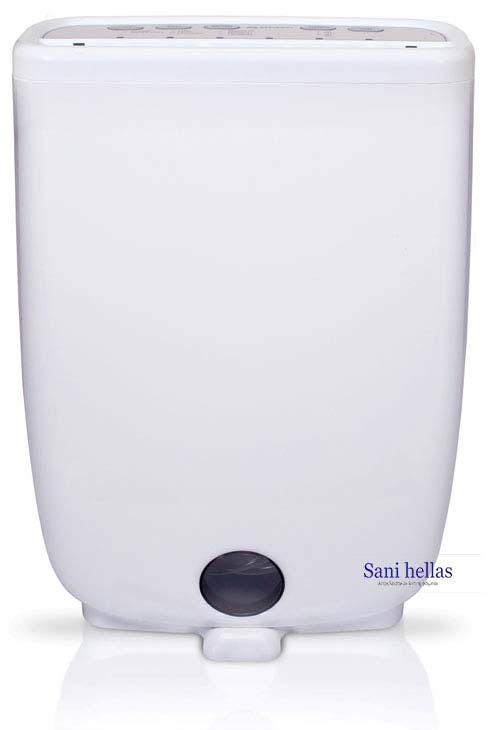
Meaco desiccant dehumidifiers utilise new dehumidification technology, without the use of a motor or compressor, unlike the dehumidifiers we have been familiar with until now. They operate on the basis of using a desiccant material, zeolite, which has the ability to trap moisture particles from the air, converting them into water that is stored in the dehumidifier’s tank or drained away via a pipe.
Desiccant dehumidifiers are 100 per cent effective at low temperatures.
The major advantage, compared with motorised dehumidifiers, is that Meaco’s new-generation desiccant dehumidifiers operate efficiently in the most extreme temperatures, from 1 to 37°C! You should be aware that a dehumidifier’s performance depends on the temperature of the room in which it is used. This is the decisive factor. It is well known that seven out of ten permanent residences are not adequately heated, or only certain rooms are heated. Therefore, when the room temperature is below 20°C, Meaco desiccant dehumidifiers are the only ones that can operate without any reduction in efficiency. This is all the more true for holiday homes, which have been closed up for a long time, without ventilation or heating. Nowadays, when heating in homes is limited or non-existent, humidity levels rise excessively, causing health problems, severe dampness on walls (mould, black spots, etc.) and on windows. In these difficult conditions, desiccant dehumidifiers are the only ones capable of effectively dehumidifying, whilst maintaining low running costs. They are 100 per cent effective from 1°C! The Meaco DD8L and Meaco DD8L Junior desiccant dehumidifiers guarantee a dehumidification capacity of 8–10 litres per day, regardless of the room temperature. In contrast, standard motorised dehumidifiers, at temperatures below 18°C spend most of their time defrosting (removing ice from the motor surface to prevent it from breaking) rather than dehumidifying!
The desiccant dehumidifier blows out warm air.
At the same time, Meaco desiccant dehumidifiers have an internal heating element, which heats the dry air before it is released into the room. Unlike motorised dehumidifiers, Meaco desiccant dehumidifiers do not cool the room air; on the contrary, they raise the room temperature by 1–2°C, helping to heat the room. You should be aware that using a dehumidifier reduces heating costs by around 20 per cent!
Desiccant dehumidifiers operate silently.
Precisely because the Meaco DD8L and DD8L Junior desiccant dehumidifiers have no motor, they operate silently. Owners of motorised dehumidifiers are immediately struck by the low noise levels of the DD8L and DD8L Junior, and this is their surprise when they see them in operation.
Desiccant dehumidifiers are energy-efficient.
Meaco desiccant dehumidifiers have low power consumption (30W whilst the fan is measuring the room’s relative humidity, 330W whilst the dehumidifier is operating to remove moisture). They feature a built-in room hygrostat, so as soon as the set relative humidity is reached, the dehumidifier switches off and consumes no electricity at all, reducing running costs to a minimum. The fan in the Meaco DD8L & Meaco DD8L Junior desiccant dehumidifiers switches to sleep mode, and after approximately 30 minutes it will restart, taking samples from the air in the room; if the relative humidity has not increased, it will return to sleep mode. In a well-insulated home, the fan will run for just 10 minutes an hour instead of 60!It should be noted that the aforementioned energy consumption includes the thermal resistance of Meaco desiccant dehumidifiers, which raises the room temperature by approximately 1–2°C. The dry air blown by the Meaco desiccant dehumidifier is around 10°C warmer than the existing room temperature!
Dehumidifiers reduce heating costs by 15–20 per centWhen a room or a house has high levels of relative humidity, what happens is that there are millions of water molecules in the air, which we only see when they condense on windows, walls and mirrors. We may not be able to see them, but they are there and we certainly feel them. In order to feel warm, you need to heat all these water molecules. In other words, heating a room with high humidity requires, first and foremost, the removal of water molecules from the air. This means that, on the one hand, it takes much longer to heat the house, and consequently, the heating costs are much higher! According to measurements and studies, using a dehumidifier can reduce heating costs by up to 15–20 per cent.
Source: Sani Hellas