Zeolites and CO₂ capture: the ‘sponge-like’ mineral that Mazda uses to clean exhaust fumes
A car that, the more it drives, the less carbon dioxide it leaves behind. It sounds like a contradiction — and yet, Mazda has just proven it under real racing conditions. At the heart of this technology lies neither an exotic catalytic converter nor an expensive battery, but a humble, porous mineral that we at Zeolife.gr know very well: zeolite.
Let’s take a look at exactly what Mazda has achieved, and, above all, why zeolite is the material that makes ‘carbon capture on the move’ possible.
Mazda’s achievement: 804 grams of CO₂ during a 24-hour race
At the Fuji 24-hour endurance race, part of the Japanese Super Taikyu series (5–7 June 2026), Mazda fitted a racing car — the MAZDA SPIRIT RACING 3 Future Concept — with an experimental system called Mazda Mobile Carbon Capture. Its aim: to ‘suck’ some of the carbon dioxide directly from the exhaust gases whilst the car is in motion.
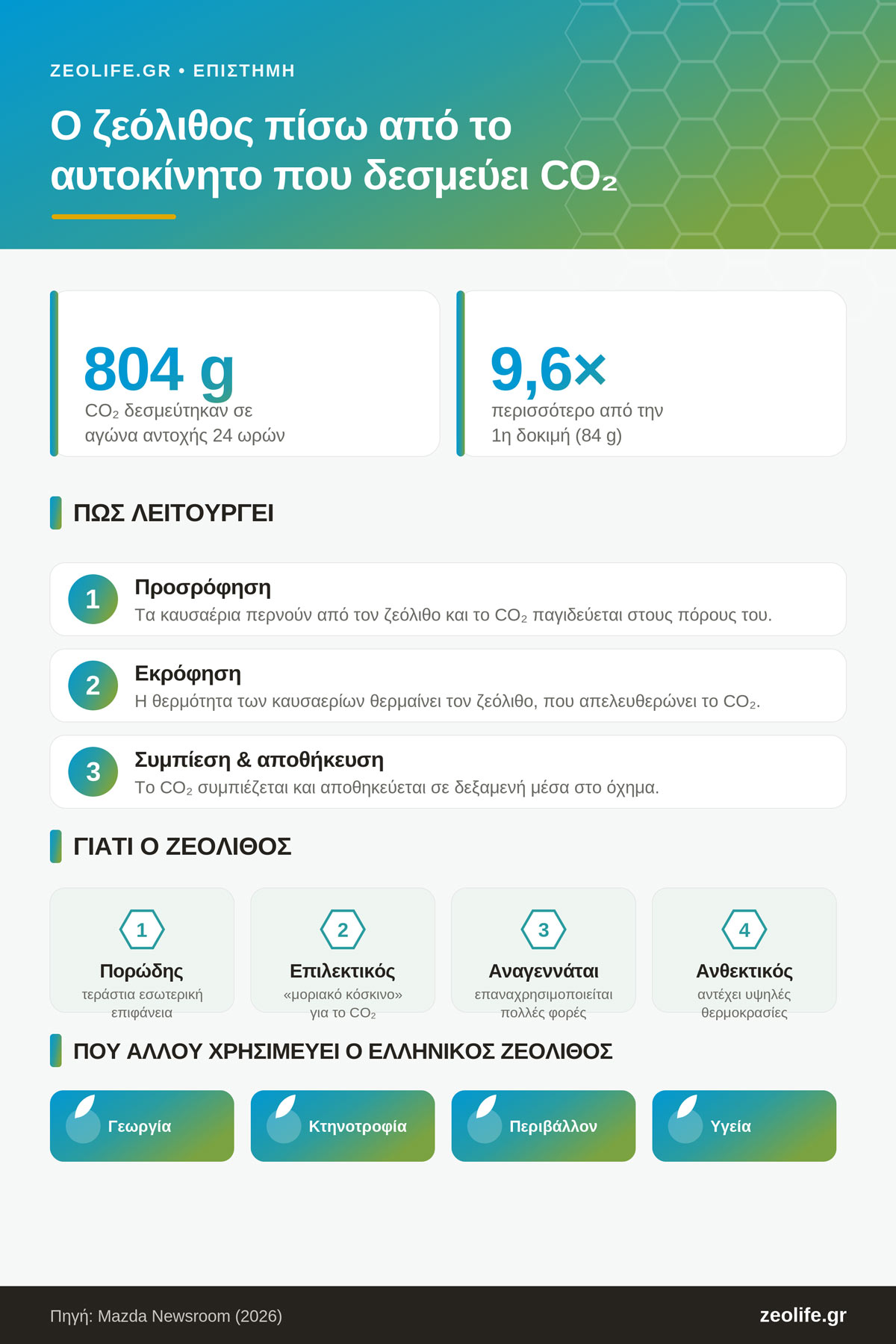
The result was the capture of 804 grams of CO₂ over the course of the race — approximately 9.6 times more than the first test in November 2025, which had captured 84 grams. In fact, it was the first time the company had completed the entire cycle within the vehicle: capture → release → compression → storage. The racing car ran on HVO (hydrotreated vegetable oil), a carbon-neutral fuel.
Mazda states that, under certain conditions, the combination of carbon-neutral fuel and emissions offsetting temporarily exceeded the threshold that would make a vehicle ‘carbon negative’ — that is, one that absorbs more CO₂ than it emits. The ultimate goal is to implement this in production models by 2035. And the key to all this is the material that fills the system’s ‘lung’.
How zeolite traps carbon dioxide
zeolite is a natural clay-silicate mineral with an impressive property: its structure consists of countless microscopic holes, channels and cavities at the molecular level. This gives it an enormous internal surface area — a single gramme can have an internal surface area of several hundred square metres. That is why we often describe it as a ‘molecular sponge’.
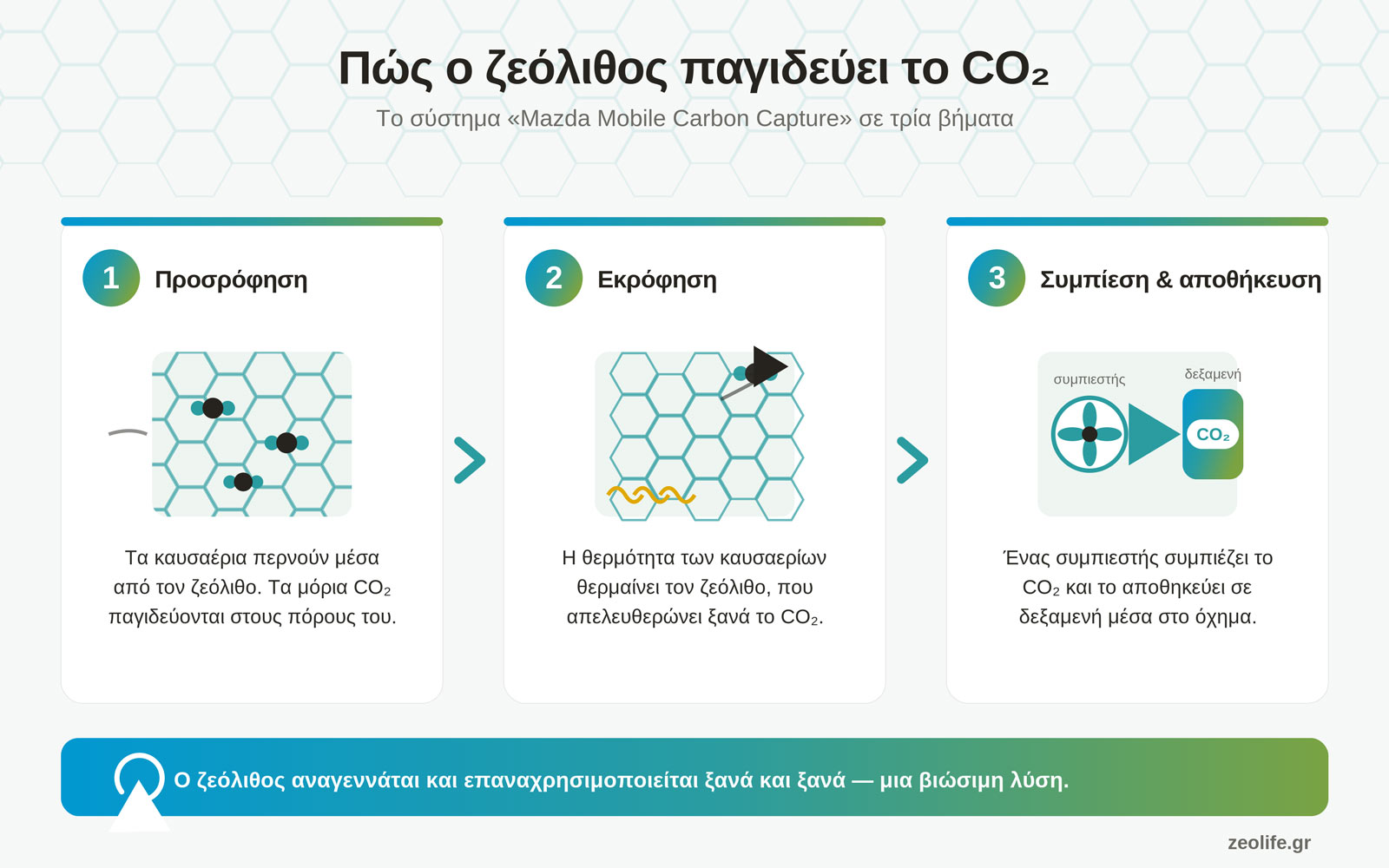
In the Mazda system, the process consists of three stages:
- Adsorption. The exhaust gases pass through a vessel filled with zeolite. As the gas diffuses into the pores, the CO₂ molecules ‘stick’ to the mineral’s vast internal surface and are trapped. Important: before reaching this stage, the exhaust gas passes through a separator that removes moisture, as water competes with CO₂ for the same sites on the zeolite.
- Desorption. When the zeolite becomes saturated, it is heated — and here’s the clever bit: Mazda uses the heat from the exhaust gases themselves. zeolite has the property of releasing the trapped CO₂ as soon as it is heated, without requiring any additional energy.
- Compression & storage. The released, now purified CO₂ is compressed by an electric compressor and stored in a tank inside the vehicle.
Because adsorption and desorption cannot take place simultaneously in the same material, the demonstration system used two units operating in turn: whilst one ‘absorbs’, the other ‘releases’. It is precisely this ability of zeolite to be loaded and reused time and time again that makes the solution sustainable.
Why zeolite is the ideal material for the job
It is no coincidence that the automotive industry has turned to a mineral that has been known for centuries. The properties that make zeolite unique are precisely those required for gas capture:
- A porous structure with a vast surface area: more space for CO₂ molecules to be ‘trapped’.
- Selectivity (molecular sieve): its pores are of a specific size, so the zeolites sorts molecules based on their size and electric charge — it does not capture everything indiscriminately.
- Thermal reversibility: it releases whatever it has bound when heated, so it can be ‘cleaned’ and reused thousands of times.
- Stability & durability: it withstands high temperatures and harsh conditions — essential in a racing car.
These are, after all, the very same properties that make zeolite so valuable for environmental protection: water and waste treatment, heavy metal sequestration, and oxygen enrichment. CO₂ capture from a car is simply the same principle, applied on a new, impressive scale.
Natural or synthetic zeolite? A useful clarification
A frank clarification is in order here. According to Japanese reports, Mazda uses a synthetic 13X-type zeolite — an industrially produced variant, popular in gas separation. The zeolite we offer at Zeolife.gr is natural Greek clinoptilolite, one of over 45 species of natural zeolites that have been recorded.
They all belong, however, to the same mineral family and share the same fundamental principle of operation: a porous, crystalline structure that selectively binds molecules and ions. clinoptilolite is also being studied internationally for CO₂ capture and gas separation, with the advantage that it is abundant, low-cost and does not require energy-intensive industrial synthesis. In other words, Mazda’s choice is no exception — it is proof that the entire class of zeolites is key to carbon capture technology.
Beyond cars: zeolites in the battle for the climate
Mazda’s experiment is an impressive showcase, but the use of zeolite for gas management is nothing new. In the hydrocarbon industry, zeolites have been used for decades as molecular sieves for the purification and separation of gas streams — for example, to remove CO₂ from natural gas or to produce oxygen and nitrogen.
What Mazda’s initiative demonstrates is that the same technology can be ‘miniaturised’ and incorporated into mobile emission sources, not just fixed industrial installations. And the captured CO₂ is not necessarily waste: it can react with hydrogen to produce synthetic fuels, be used as a plant fertiliser, or feed microalgae cultures — from which, in turn, new carbon-neutral fuels are produced. This is how the carbon cycle is closed.
There are, of course, limitations: 804 grams is still a small amount in absolute terms, and the major challenge remains scaling up — how do you capture much more CO₂ without the system becoming excessively heavy and bulky (the exhibition model already weighed around 50 kilograms). But the direction is clear, and the key player remains the same.
Greek zeolite: the same ‘smart’ mineral, right in your hands
From the racetracks of Japan to the field, the stable and the home, the ‘magic’ of zeolite is always the same: a porous structure that binds, filters and purifies. The very same mineral that Mazda uses to trap CO₂ from exhaust fumes, binds heavy metals in water, retains nutrients and moisture in the soil, and supports the body’s detoxification.
Greek Thracian clinoptilolite is one of the highest-quality natural zeolites. If you’d like to make the most of its properties too — in agriculture, livestock farming, in the garden or at home — you can browse our products in our online shop, or find out more about what zeolite is and where it’s used.
The next time you hear about a ‘car that cleans the air’, you’ll know which Greek — and ancient Greek-named — mineral lies behind it.
Frequently asked questions
How does zeolites capture CO₂?
zeolite has a porous, crystalline structure with a vast internal surface area. As gases pass through it, carbon dioxide molecules adhere (are adsorbed) to its internal surfaces and are trapped. When heated, the zeolite releases the CO₂ again so that it can be collected — and is then ready to be reused.
Does the zeolite ‘run out’ once it has bound the CO₂?
No. One of its major advantages is that it is regenerable: when heated, it ‘empties’ and can be reused many times. That is why it is considered a sustainable and cost-effective material for capturing gases.
Is Mazda’s zeolite the same as the zeolite you sell?
They belong to the same family of minerals and operate on the same principle, but Mazda uses a synthetic zeolite (type 13X). zeolite from Zeolife.gr is natural Greek clinoptilolite, ideal for agriculture, livestock farming, domestic use and detoxification.
Where else is zeolite used for gas absorption?
In industry, zeolites have been used as molecular sieves for decades — for removing CO₂ from natural gas, separating oxygen and nitrogen, purifying gas streams and dehumidification.
Sources: Mazda Newsroom (press releases of 8 June 2026 & 17 November 2025), webCG, Nikkan Jidosha Shimbun, Autoblog.gr. The technical data on the zeolite type (13X) is taken from Japanese publications.