zeolite as a means of ammonium recovery and secondary processing of cheese whey. [Study]
In a recently published study by the University of Patras, the effectiveness of natural zeolite in removing ammonium ions from synthetic wastewater and from secondary whey was investigated.
The aim of the study was to recover nitrogen-containing nutrients via zeolite, which can then be used for further applications, such as slow-release fertilisers.
zeolite with a clinoptilolite content of at least 85 per cent from Kardzhali in Bulgaria was used; its technical specifications can be viewed here: Zeolite, 2.5 to 5 millimetres
Experiments and results for industrial effluents
Experiments were carried out in flasks and fixed-bed columns to examine the effect of various operating conditions on zeolite performance.
The adsorption experiments were carried out using synthetic wastewater and zeolite of different particle sizes (i.e. 0.71–1.0, 1.8–2.0, 2.0–2.8, 2.8–4.0 and 4.0–5.0 mm). According to the results, the particle size distribution of the zeolite had no significant effect on its ability to adsorb ammonium ions. Nevertheless, the smaller particles (0.71–1.0 mm) exhibited faster rates of ammonium ion adsorption, reaching up to 93.0 per cent within the first 10 minutes. The maximum ammonium removal efficiency from the zeolite was achieved at ammonium concentrations ranging from 10 to 80 mg/L.
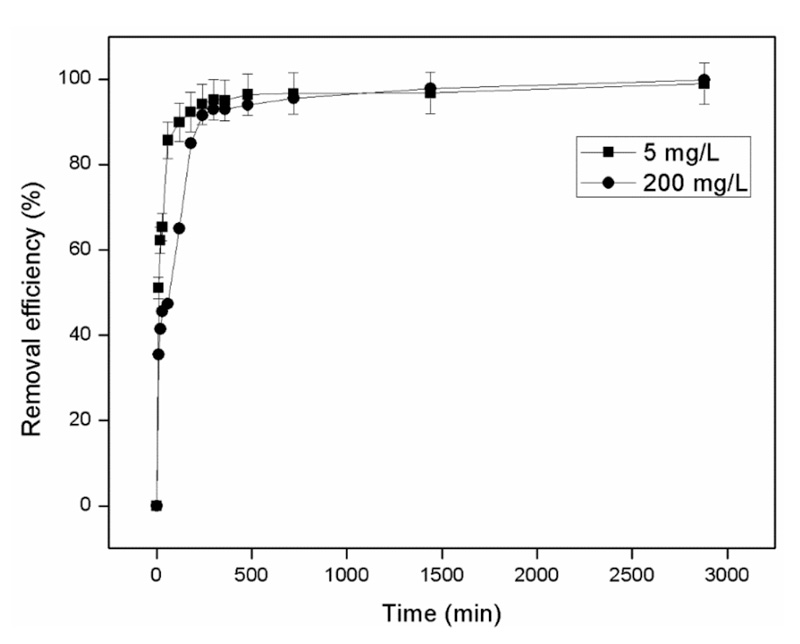
Kinetics experiments revealed that chemical adsorption is the mechanism behind the adsorption of ammonium ions by zeolite, whilst the Freundlich isotherm best fits the experimental data.
Column experiments using a synthetic solution with an initial ammonium ion concentration of 200 mg/ L revealed that, for all particle sizes tested, the zeolite was capable of absorbing almost the entire available concentration of ammonium ions (over 99 per cent) within the first 120 minutes. The same was not observed for the initial concentrations of 5,000 mg/ L, where only the zeolite with particle sizes of 0.71–1.0 mm managed to remove over 99 per cent of the ammonium ions (99.9 per cent) within 120 minutes. All zeolite particle size fractions reached equilibrium much later (24 hours, 96 per cent–97 per cent removal of NH₄⁺-N).
Experiments and results of the treatment of secondary whey
Natural zeolite can be used as an alternative substrate for the treatment of secondary whey, as it can achieve significant removal of the organic load (up to 40%, 14.53 mg COD/g zeolite) and ammonium ions (approximately 99 per cent).
As regards orthophosphate ions, the zeolite appears to reach saturation after the first day of the experiments, with a removal capacity of 0.15 mg P/g zeolite.
Elution experiments using deionised water in flasks and columns showed low elution rates for ammonium and orthophosphate ions, thus indicating that this zeolite could be used as a substrate for the slow release of nitrogen into soils.
Furthermore, the prolonged use of zeolite in the treatment of whey (after three days) led to the formation of biomass, thereby increasing the rate of organic load removal.
Read the study here