In vitro comparison of zeolite (clinoptilolite) and activated carbon as ammonia absorbents in fish farming – In vitro Comparison of Zeolite (Clinoptilolite) and Activated Carbon as Ammonia Absorbants in Fish Culture
H. Emadi, J.E. Nezhad and H. Pourbagher
Abstract
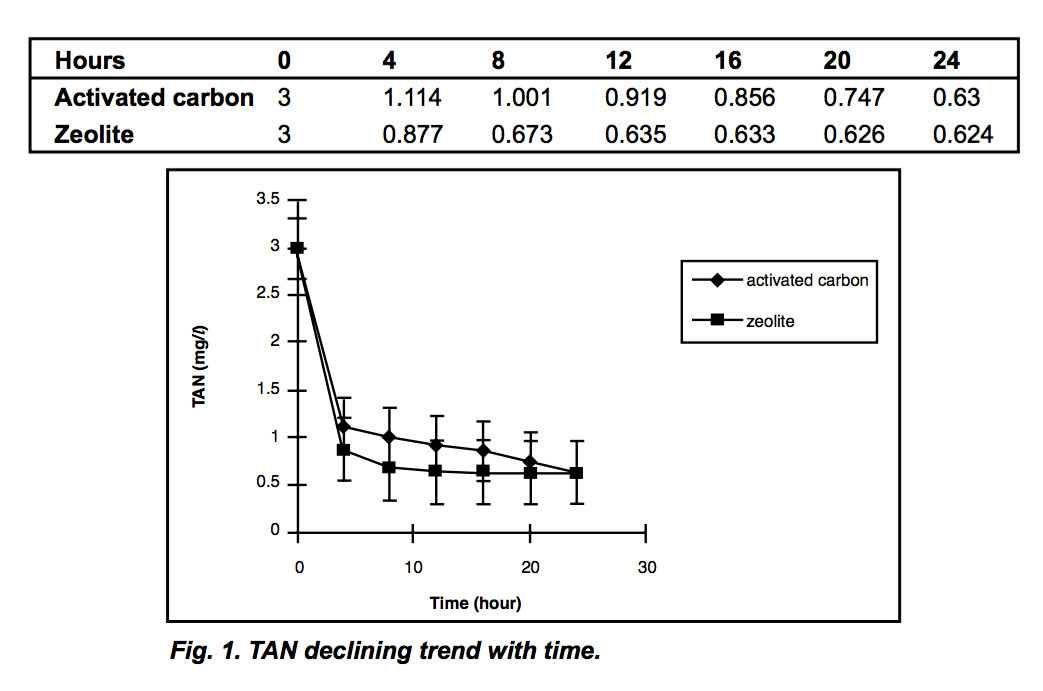
Conditioned activated carbon was compared with zeolite (clinoptilolite) at different salinities, total ammonia nitrogen (TAN) levels and time intervals. The dosages of both materials were the same, i.e. 10 ppt. Different salinities ranging from 0 to 30 ppt were prepared in 24 three-litre plastic buckets. Concentrations of 1, 3 and 5 ppm TAN were added to the buckets. The trend in TAN absorption was monitored every 4 hours over a 24-hour period. It was evident that, over time, the amount of TAN removed decreased for both materials. No change was observed in the buckets containing zeolite after 8 hours. A similar trend was observed for activated carbon; however, despite the decreasing rate of absorption by activated carbon, the absorption of ammonia (TAN) by both materials decreased. The greatest difference between these two materials was observed at a salinity of 0 ppt, whilst the difference was not significant at a salinity of 30 ppt. After 24 hours, the concentration of TAN in buckets containing 1, 3 and 5 ppm TAN had decreased by 80.8 per cent, 65.4 per cent and 58.8 per cent, respectively.
At the conclusion of the study, a significant difference was observed between zeolite and activated carbon, and the results obtained with zeolite were found to be more satisfactory than those with activated carbon.