zeolite improves crop growth in soil contaminated by industrial waste and heavy metals
Soil contaminated with heavy metals and industrial waste is unsuitable for almost any type of crop. However, a new study has revealed that making a simple change could turn things around. Researchers at the Agricultural University of Tirana have discovered that simply adding natural zeolite can serve as an effective method for remediating soil contaminated with heavy soils. They observed significant variations in the changes depending on the proportion of zeolite in the soil, but overall the results appear to have been largely positive. The details of their research have recently been published in the Albanian Journal of Agricultural Sciences.
Soils that have been exposed to heavy metals and become contaminated produce correspondingly contaminated plants. Consequently, these types of soil pose a major threat to human health. Even the simplest cases of heavy metal contamination are considered dangerous, with the highest risk of exposure to metals such as arsenic, cadmium, lead and mercury. According to numerous studies, these types of heavy metals have specific adverse effects on human health and must therefore be avoided at all costs.
In most cases, the best way to avoid the adverse effects of soil contaminated with heavy metals is to choose to grow crops on one’s own land. This is land they can monitor and where they can detect any potential heavy metal contamination. Of course, this is not always a viable course of action. So what is the best course of action? Soil remediation appears to be the next best option.
Although there are several well-known remediation methods for contaminated or unhealthy soil, in this particular case, the researchers sought to test the effectiveness of adding natural zeolite. What they observed after collating their data was that not only can zeolite improve soil conditions, but it can also boost yields to levels higher than they had anticipated.
In case you are not familiar with them, natural zeolites are a large group of minerals that can be characterised as microporous and consist mainly of hydrated aluminosilicate salts of barium, calcium, potassium and sodium. They are frequently found as secondary minerals in volcanic rocks and are often used as adsorbents and catalysts.
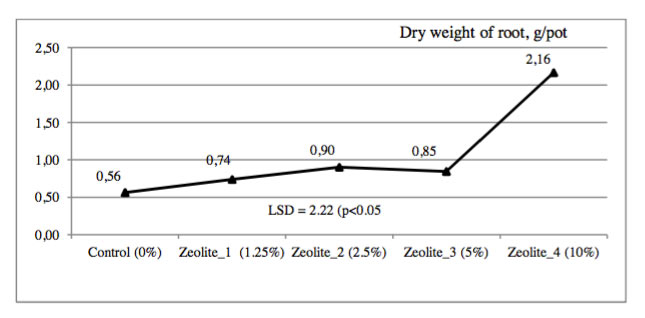
This research study focused on the growth of ryegrass (Lolium multiflorum L.) using various zeolite concentrations in soils contaminated with heavy metals. Four different rates of zeolite incorporation into the soil were used: 1.25, 2.5, 5 and 10 per cent by weight, in a randomised design with four replicates. The plants were grown for 82 days in a greenhouse at the Agricultural University of Tirana. The researchers observed that, when zeolite was applied at a rate of 10 per cent, plant height increased significantly (by 25.2 per cent) at the second harvest. They also observed that the plants’ growth rate increased in proportion to the percentage of natural zeolite in the soil. A simultaneous and proportional increase was also observed in the root-to-shoot ratio shoot ratio of the plants, thus demonstrating that zeolite can act as an excellent growth regulator for crops in soil contaminated with heavy metals.
Chrysovalantis Hatzigeorgiou
source: sites.google.com
thesis (pdf): drive.google.com