Growth and flowering of tuberose as affected by the addition of natural zeolite
Abstract
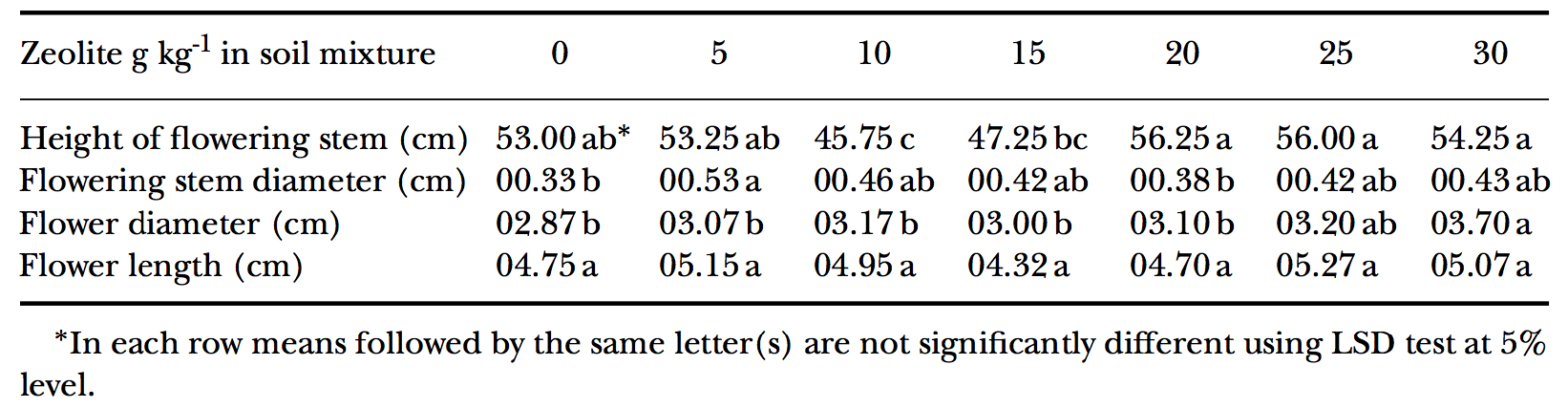
This research was conducted to investigate the effect of natural zeolite on the vegetative growth and flowering of tuberose (Polianthes tuberosa L.). The experiment was carried out using a completely randomised design with seven treatments (5, 10, 15, 20, 25 and 30 g zeolite per kg of soil mixture, plus a control) and four replicates. The results indicate that zeolite increased the height of the flowering stem, the diameter of the flower, the leaf area and the chlorophyll content, but decreased the diameter of the flowering stem, the dry weight of the shoots, and the dry weight of the roots and bulblets. Overall, zeolite added to the soil mixture had beneficial effects on only some of the parameters of tuberose growth and development.
INTRODUCTION
Tuberose (Polianthes tuberosa L.) is one of the most important cut flowers in tropical and subtropical regions. The florets have a very sweet fragrance. In India and France, tuberose is widely cultivated as a source of essential oils for the perfume industry. Polianthes is also a common garden plant in spring and flowers during the summer and early autumn (De Hertogh and Le Nard, 1993). In recent years, there has been considerable interest in the development of sustainable agriculture and, consequently, in the use of natural minerals as soil amendments to improve the physical and chemical properties of the soil (Abdi et al., 2006). Zeolites are a naturally occurring group of minerals comprising around 50 different types. They have a rigid three-dimensional crystal structure with voids and channels of molecular size and a high cation exchange capacity (CEC) resulting from the substitution of aluminium (Al) for silicon (Si) in the silicon oxide tetrahedral units that constitute the mineral structure (Pickering et al., 2001). Other properties of zeolites include their high absorption capacity, water retention and high buffering capacity against changes in pH (Allen and Ming, 1995). The agricultural interest in the application of soil mixtures stems from the materials’ ability to prevent water wastage and the leaching of nutrients. These characteristics of soil mixtures not only reduce irrigation and nutrient costs, but also alleviate growers’ concerns regarding water and soil pollution (Nazari et al., 2007). The high cation exchange capacity (CEC) of zeolites and their ability to retain water and nutrients lead to improved yield and fruit quality (Djedidi et al., 1997). The high exchange potential for the cations ammonium (NH₄⁺) and potassium (K⁺) has been regarded as an important property of zeolites (Maloupa et al., 1999). Different types of zeolite, and the same type of zeolite from different deposits, vary in their chemical and physical properties and hence in their suitability for agricultural use (Pickering et al., 2001). The application of natural zeolite to the potting mix resulted in a significant increase in photosynthesis, mesophyll efficiency, water-use efficiency, chlorophyll content, dry weight of roots and shoots, leaf area and flower length in Tagetes erecta L. ‘Queen’ (Nazari et al., 2007). Zeolites are reported to increase yield in several crops, e.g., wheat (Triticum aestivum L.), aubergine (Solanum melongeana L.), carrots (Daucus carota L.), tomatoes (Lycopersicon esculentum L.) and peppers (Capsicum annuum L.) (Mumpton, 1999). It is reported that gerbera (Gerbera jamesonii L.) performed better on zeolites than on perlite or rockwool soil amendments (Issa et al., 1997). Zeolites are available in Iran and are second in abundance only to iron ore (Fotoihi Ghazvini et al., 2007). The aim of the present experiment was to investigate, for the first time, the effect of natural zeolite on the vegetative growth and flower characteristics of tuberose.
source: tandfonline.com
Products from this article
Everything for farming in the shop → Foliar and root sprayEcoPlant® – Soil and Foliar Improver – 1 litre★★★★½ (43)
 Holds water and nutrientsGreek Thracian zeolite from 0 to 2.5 millimeters – Powder and fine gravel, ideal for incorporation into small-scale crops and medium to light soil – 25 kg★★★★★ (1)16,90 €View →
 Powder up to 1 mmGreek Thracian zeolite up to 1 mm – powder, ideal for incorporation in very small scale crops and light soil – 25 kg16,90 €View →