Olive mill wastewater treatment using a simple, low-cost zeolite-based method
Olive mill wastewater (OMW), a liquid by-product of the olive oil industry, represents a severe environmental problem owing to its high pollution load. In this study, successive columns containing different types of natural materials were investigated for their OMW treatment efficiency. Passing OMW through three columns of gravel, fine sand, and a mixture of acidified cotton and zeolite (weight:weight ratio of cotton:clinoptilolite of 2:1), followed by treatment with activated charcoal (AC) and lime, was the best treatment in terms of the quality of water obtained. This treatment decreased concentrations of −3NO, B, K, P, and total fat in OMW by mean percentages of 78.0, 92.4, 66.6, 48.3, and 93.3%, respectively.
Furthermore, it decreased OMW turbidity and electric conductivity (EC) by 96.8 and 48.4%, respectively. Most contaminants were removed from the OMW in the cotton/clinoptilolite column owing to the high sorption affinity of clinoptilolite on its active sites. The AC was efficient for organic particle removal; meanwhile, lime was used to raise the pH of the treated OMW (TOMW) from 2.9 to 5.1. This simple method enables us to obtain environmentally friendly TOMW that can be safely used for irrigation.
http://www.sciencedirect.com/science/article/pii/S0301479714003521
Products from this article
Everything for farming in the shop →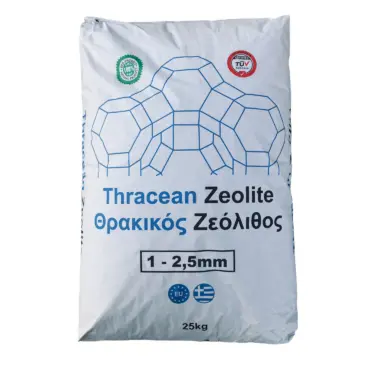 For young olive treesGreek Thracian zeolite from 1 to 2.5 mm – fine gravel, ideal for incorporation in small scale crops and medium to heavy soil – 25 kg★★★★★ (1)16,90 €View →
 For olives · 2.5–5 mm gravelGreek Thracian zeolite from 2.5 to 5 mm – Gravel, ideal for incorporation into large-scale crops – 25 kg★★★★★ (5)16,90 €View →
 Foliar and root sprayEcoPlant® – Soil and Foliar Improver – 1 litre★★★★½ (43)