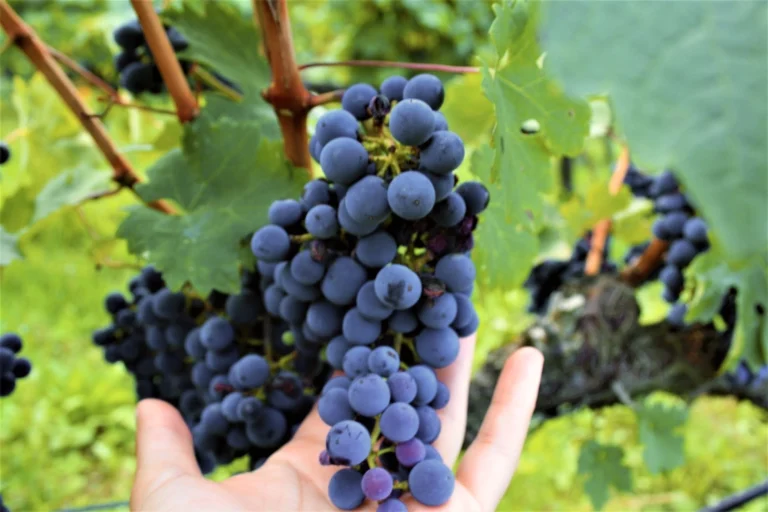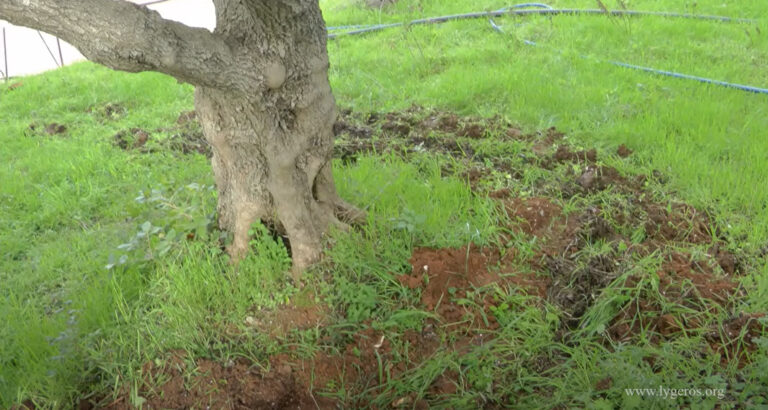
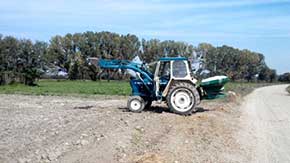
Zeolite-treated garlic in the Nea Orestiada plain
Zeolite applied to garlic in conventional cultivation on the plain of Nea Orestiada. Application particle size: 2.5 to 5 millimetres.
How is zeolite applied?
zeolite is applied in agriculture by incorporating it into the soil at rates of 450 to 600 kg per stremma, depending on the soil type and its particle size distribution (fineness of the material). In heavy soils, zeolite in gravel form (2.5–5 mm) is preferred, whilst in light soils, it is preferred in the form of fine gravel (0.8–2.5 millimetres). A quantity of 450–600 kg per stremma is required to maximise its contribution to increased yields, depending on the crop. Its beneficial effect is long-lasting (zeolite does not decompose like other materials) and, once the three-year incorporation period for conventional crops is complete, you will not need to add any more for the next 10 years, whilst continuing to reap its benefits every year. In this way, the cost is spread over a greater number of years.
Below is a detailed breakdown of the beneficial properties of zeolite in agriculture.
- It increases nutrient retention capacity (its cation exchange capacity ranges from 220 to 400 meq/100g and is twice that of bentonite)
- It reduces nutrient losses due to volatilisation (nitrogen losses in the form of ammonia) or leaching (nitrite and nitrate) and consequently helps to reduce the amount of fertiliser used by 20–25 per cent. It is therefore recommended that it be added during the composting of plant material and animal manure, starting with the floors of livestock housing.
- When used in conjunction with fertiliser, it can help to ensure the gradual release of nutrients, thereby preventing losses whilst, at the same time, supplying plants with nutrients over a longer period.
- Using less fertiliser and water promotes good soil management and reduces pollution caused by fertiliser leaching into the water table.
- It delivers impressive results in terms of plant growth rates, reduces root system diseases, and increases the yield and quality of agricultural produce.
- It increases water retention capacity and ensures the even distribution of water throughout the soil, particularly in sandy soils (zeolite retains water equivalent to 42–50 per cent of its weight, which it releases to the plants gradually). Essentially, we create microscopic reservoirs of water scattered throughout the field, which refill with every rainfall to supply water to the plants during periods of drought.
- It increases the availability of phosphorus and potassium, absorbs and traps toxic contaminants, and promotes a balance of alkaline metals.
- It neutralises acidic components in the soil (raising the pH) and therefore no other materials need to be added.
- It is a 100% natural product suitable for use in organic farming.
- Its beneficial effects are permanent as it does not degrade like other soil improvers.
- It is cost-effective when calculated on an annual basis over the entire period of the benefits it provides, it increases fruit yield whilst ensuring uniformity of production and combines excellently with active microorganisms in many applications, enhancing their action. As a direct consequence of all the above, it eradicates pathogens and weed seeds.
- It increases yield and improves the quality of the produce, which also has a longer shelf life at the point of sale.
- It can be used as a growing medium to support the cultivation of hydroponic crops in Mediterranean conditions, for vegetables, cut flowers and aromatic plants, yielding high-yield, high-quality produce.
- It combines perfectly with active microorganisms, enhancing their action.
- As a silicate, it deposits silica in the cell walls of the stems, reducing lodging.
- It enhances resistance to diseases and pests (powdery mildew, aphids, cycloconium). It protects plants from stress in adverse conditions.
- It strengthens plants under abiotic stress (drought and frost).
- It increases photosynthetic efficiency – dry matter.
- It reduces sodium uptake. It helps plants withstand salinity and toxic levels of Mn, Fe and P.
- In hydroponic cultivation, it has increased yields by promoting a thicker, whiter and healthier root system.
- The following crops benefit particularly from its use: vines, olive trees, peach trees, apricot trees, citrus trees, other fruit trees, potatoes, tomatoes, cucumbers, peppers, parsley, other vegetables, etc.
- It has proven its ability to release nutrients slowly and naturally into the root system of young plants, thereby increasing their vigour and yield.
- zeolite-infused garlic has produced remarkable results in promoting their growth, as well as in combating fungi that develop both below and above ground.
Products from this article
Everything for farming in the shop →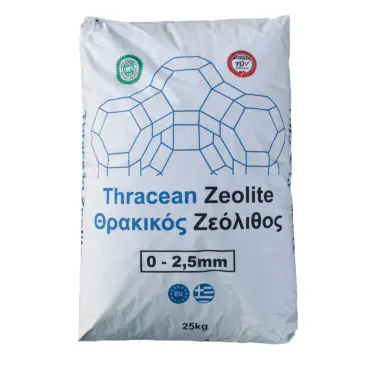 Powder and fine gravel 0–2.5Greek Thracian zeolite from 0 to 2.5 millimeters – Powder and fine gravel, ideal for incorporation into small-scale crops and medium to light soil – 25 kg★★★★★ (1)16,90 €View →
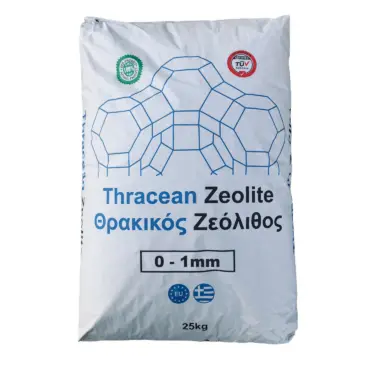 For vegetable gardensGreek Thracian zeolite up to 1 mm – powder, ideal for incorporation in very small scale crops and light soil – 25 kg16,90 €View →
 Crop enhancerZeTe – Zeolite crop enhancer – for maximum performance and strength – 15Kg50,00 €View →