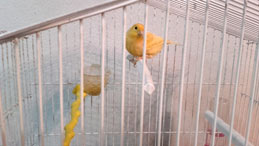
Zeolite for a canary in Nea Orestiada
The canary is a songbird of the order Passeriformes and belongs to the family Fringillidae. The official name of the domestic canary is *Sirinus canaria domesticus*.
History
Canaries were introduced to Spain in the 15th century following the Spanish conquest of the Canary Islands. Following a shipping accident, a large consignment of canaries escaped and soon spread throughout Europe. It is also possible that the canary is descended from the wild canary (Serinus canaria canaria), which is native to the Canary Islands, Madeira, the Azores, Tenerife and other locations.
Varieties
Domestic canary
Canaries are divided into three main categories:
- Dutch canaries. They are large, have soft plumage, but are not particularly noted for their song.
- German canaries. They have beautiful colouring and a lovely song.
- English canaries. They are dark yellow in colour, though this changes to yellow-red or yellow-orange due to their artificial diet, which consists of pepper, sugar, flour and boiled egg.[1]
Some countries breed canaries for their song, whilst others do so for their colour. There are various species of canary, which are grouped into separate categories according to their specific characteristics. They are categorised on the basis of their different songs, their different colouring and their different physical appearance – with or without a crest, curly-feathered, and so on. The wild canary also belongs to this group. It has green plumage with grey streaks and yellowish tints on the head and back. It can easily interbreed with the goldfinch, the chaffinch and the brambling. In the eastern Mediterranean, another species of canary lived, the domestic canary, which is descended from the wild canary and began to be introduced into Europe in the late 16th century. The various species of canary that exist today are the result of cross-breeding and mutations brought about by breeders. In Malin, the local inhabitants breed another melodious canary, the Malinois, which has metallic notes, mid-range and high-pitched notes, as well as water-like and nightingale-like sounds, amongst others. In England, old breeds of canaries are cross-bred to create new, large-bodied canaries that take their names from the towns of the same name where they were bred. In France, there is the curly-tailed canary from Paris; in Belgium, the distinctive hunchbacked canary; and many others in various countries and regions. The canaries of the Harz Mountains are renowned for their song.
From Wikipedia, the free encyclopaedia
For livestock
Everything for livestock →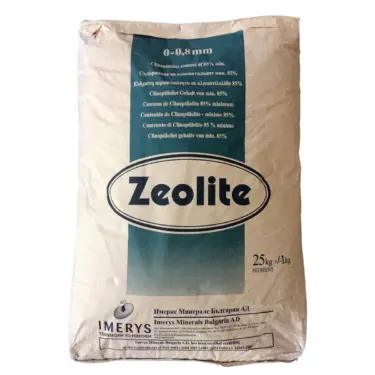 Feed + bedding · 2%Zeolite up to 0.8 mm – Powder for livestock use, animal feed and bedding, FAMIQS certified – 25 kg★★★★★ (2)18,90 €View →
 In feed · 1%Zeofeed® – Activated zeolite, up to 50 microns – Extremely fine powder, ideal for livestock use, FAMIQS-certified – 25 kg23,90 €View →
 For a few animals · 500 gZeolite up to 0.063 millimetres – Very fine powder, the finest grain size available – 500 grams★★★★★ (1)4,50 €View →


![Lecture by Nikos Lygeros on the topic: ‘The gift of life: zeolite’. Didymoteicho, 12 March 2014 [Video]](https://zeolife.gr/wp-content/uploads/2026/09/zeolife-card-2196-768x403.jpg)